"Thou shalt not make unto thee any graven images." So states the second of the ten famous commandments given to Moses. Further stipulations state that this includes likenesses of things in heaven, earth, and under the earth. "Under no circumstances can [poetry] be admitted to the city." So states Plato in The Republic. These two bans share some similarities. Both are administered for the sake of the Truth. God commands that the children of Israel should not pursue certain kinds of artwork for it will turn them away from Himself. Plato believes that artwork is thrice removed from Truth, an imitation of an imitation and will consequently turn those who love it from the pursuit of wisdom. However, upon further investigation we shall see that they diverge fundamentally on the issue of the material.
In Exodus, God commands that images should not be made. However, over the next few chapters God explicitly commands the creation of images. Of things in heaven (cherubim) and things on earth (almond blossoms). He even explains that he has ordained Bezalel and Oholiab as chief craftsmen. These items were not mere decoration, they were holy and to be kept with reverence. One could not even touch the Ark of the Covenant without forfeiting their life. So perhaps the second commandment was not to be taken seriously and only had some kind of metaphorical meaning? Not in the least. For while God is giving Moses these instructions, Aaron and the children of Israel are making an image for themselves. The infamous Golden Calf. What followed was an extreme act of iconoclasm in which the calf was utterly destroyed and even eaten - a profound reduction for a god to be submitted to. So what is the reconciliation of the seemingly contradictory ban and command? I will turn to a rather simplified interpretation of Jean Luc Marion's distinction of idol and icon to lead us through.
For Marion, the idol as that which "fills the gaze." The gaze is what makes the idol, and not the other way around. Therefore, the only invisible element to the idol is the gaze turned towards it. The idol has captured the gaze and reflects back the gaze. The gaze can go no further than the visible object that is the idol. Consequently, an idol is that which contains within itself a claim to truth and a final end. For Marion, the icon is the inverse. The icon refers to the invisible, and any attempt to make the invisible visible is unfulfilled. The icon, then, only points the gaze onward beyond itself. This is the difference between the ban and command of images in Exodus and Deuteronomy. The images in the tabernacle did not claim to contain and end in themselves, in fact, the very function of these images prove this. The altar is not something to be worshiped, but something on which to offer worship. The Golden Calf, on the other hand, was worshiped for its own sake. It claimed the gaze of the Israelite people. Therefore, we might go as far as to say that god condemns images that claim an end in themselves, but not those which point to himself. This is where Plato disagrees.
In The Republic, Plato almost laments the fact that he must ban the poets. admitting to his "love and reverence" for Homer. However, he goes on to claim that the painters and the dramatists are both three steps from reality in their work. There is the true bed, which the carpenter copies to make a particular bed, which is what the painter copies in his picture. This is brought into sharper contrast by the fact that the painter must paint with only one perspective. A bed is the same bed no matter what angle you look at it, but the painter must settle for only one angle. This makes it an illusion of that which is "surely far from the truth." He goes in to say that "the entire tribe of poets - beginning with Homer - are mere imitators of illusions of virtue...They don't lay a hand on the truth." For Plato, in a certain sense, all of art is like Marion's idol. It can only attract the gaze unto itself to delight the eye or ear, but it cannot point the mind towards truth, in fact, it does the exact opposite. However, there is no possibility of an icon for Plato. The more one is educated in the pursuit of truth, the more apparent the corruption of art truly is. I think we can follow this line of thought even further back than Moses and Plato to Abraham and Homer himself with the help of Auerbach.
Auerbach uses the stories of Odysseus' scar and the sacrifice of Isaac to compare two utterly different perspectives of reality. Homer fits in the story of Odysseus' scar during the build up to the final conflict of the Odyssey. However, it is not intended to build suspense, instead it is intended to "relax the tensions." But more importantly, this digression back to Odysseus' childhood comes from Homer's impulse to "represent phenomena in a fully externalized form, visible and palpable in all their parts." Nothing can happen in the epic without the reader knowing all there is to know about it, indeed there is "never a glimpse of an unplumbed depth." Everything happens in the foreground. The reader of Homer is an objective viewer, an omniscient being that knows everything that occurs in full detail, every thought, word, speech is told and explained. The Old Testament account could not be more different.
In contrast to the unified and single layer of Homer, the story of Abraham and Isaac has many layers and many unplumbed depths. At the beginning of the story God, seemingly from nowhere, calls to Abraham. We are not where he speaks from or his reasons for doing so. "He has not, like Zeus, discussed them in set speeches with the other gods in council." We do not know much about Abraham's whereabouts either, only his "moral" position to God in his response of "Here am I." The only thing we are told of Isaac is that he is Abraham's only son and the one whom he loves. No description of Isaac's features, personality, or indeed if had been scarred on his ankle at an earlier point - much less the account of how this might have happened. The reader is left with many questions and concerns about the story, much is left in the dark. "Since so much in the story is dark and incomplete, and since the reader knows that God is a hidden God, his effort to interpret constantly finds something new to feed upon. Doctrine and the search for enlightenment are inextricably connected with the physical side of the narrative." This "physicality" is the key, I think, in understanding the core difference in the way one of the methods is iconic and one is idolic.
Homer's highest end is to delight his audience. Auerbach says "The oft repeated reproach that Homer is a liar takes nothing from his effectiveness, he does not need to base his story on historical reality, his reality is powerful enough in itself." "And this 'real' world into which we are lured, exists for itself, [and] contains nothing but itself." Auerbach, in a sense, agrees with Plato's conclusion about Homer. Homer is not concerned with reality, but with aesthetic pleasure. It is an end to itself. However, the Old Testament is extremely concerned with reality. Auerbach says that the Biblical narrator's story "was not primarily oriented towards realism; it was oriented toward truth." And furthermore they "are made concrete in the sensible matter of life." This distinction aligns nicely with Marion's differentiation of icon and idol. It also explains why the Old Testament law is capable of being more nuanced with regards to the arts, it affirms materialty. Material things are capable of showing the way to truth, whether it be a golden ark, or poetry, or ultimately the Incarnation. The material can point in a reliable way to the invisible. For Plato, the visible is already at a remove from the truth, and artwork based on the material is at an even further remove.
Both the Old Testament and Plato are concerned with the validity of image-making and artwork at large. They both recognize that images have the ability to lead people astray, and both demand banishment. However, the Old Testament recognizes that artwork is not inherently corrupt, but only when it functions as an idol. In fact, when images are banned it is only because they have caused the people to stray from God. Whether they be literal stone and metal (Deut 7:25) or metaphorical (Ezekiel 14:23). It is not the material, or the act of image-making that was banned, it was idolatry. There are times when image-making is commanded with the intention to function as icons - whether it be an altar or a brazen serpent. Plato cannot give material this privilege for it is all an illusion and must forever part ways from his beloved Homer.
Exodus ch. 20-40
The Republic bk. X
God Without Being ch. 1
Mimesis ch. 1
Sunday, February 22, 2015

Friday, October 10, 2014
Tolstoy on Art
That great thinker and artist, Count Tolstoy, in the course of his life turned his formidable mind to many varied topics. Among these is the question of the onology of art and its proper role in society. He addresses these issues and investigates many examples of art from different periods and media to determine whether or not they are real and if they are good. His ideas about art are most comprehensively formed in his essay "What is Art?"
He begins by defining art as a form of communication. However, in contrast to words and speech which convey ideas, artworks convey feelings. In particular, by the use of devices that will invoke whatever feeling the artist wants to share in the viewer/listener. In contrast to his views on the ontology of artwork, he proceeds upon an impressively erudite diatribe against aesthetic theory from Baumgarten to his contemporaries. He has two main problems with these thinkers. The primary flaw that he sees in aesthetics is that it transfers the question of what art is to the "realm of metaphysics." In other words, for Tolstoy, all these thinkers simply claim that art is about beauty or pleasure and proceed to build their theories on how one judges these properties. This leads to other problem that he sees, and that is that these theories are shifty and are malleable enough to simply absorb any kind of artwork thereby defeating the purpose of claiming to have truth about what art is and more specifically what good art is. I can see the truth in this by the way anti-art like Duchamp's The Founatin is absorbed into the canon of art.
After he makes the distinction between art and Beauty, he explains the way he sees art coming into existence and how its value is determined. Quite simply, the value of an artwork is dependent on the respective culture's ideas about the meaning of life. The meaning if life is determined by what is morally good and evil. And morality is determined by the religion of the culture. An important break in this narrative is the Renaissance. He says that the upper class lost faith in the church and therefore continued to make art in the vein of the church but whilst actually worshiping not God but Beauty itself. Perhaps this is the first real divide in upper and lower art.
After explicating what art is and how it comes to be valued and judged and where the story took a new turn with the seeking of Beauty for its own sake, he explains more specifically what good art is. There are three things that he specifically does not have patience for in art. First, imitation. If art is the pure feeling that is communicated to the viewer than imitation art is that artwork that instead of trying to capture that feeling from the experience itself but instead from another work of art. He gives the example of Faust by Goethe as false art because of this. Secondly, if the artwork has the wrong moral message. This occurs when the artist has an incorrect view of morality. Therefore, this has two parts. Obvious examples for him are artworks that try to glorify art itself or worse, sexual lust. He gives examples of paintings that contain the nude human form and also lots (lots!) of French verse describing scenes and acts of debauchery. Third, art that does not connect with its viewer. If the viewer cannot receive a feeling or invocation from the art than the art has failed. He uses the example of how a peasant cannot understand the Ninth Symphony and therefore is not good art in contrast with the joyful song of a peasant.
He begins by defining art as a form of communication. However, in contrast to words and speech which convey ideas, artworks convey feelings. In particular, by the use of devices that will invoke whatever feeling the artist wants to share in the viewer/listener. In contrast to his views on the ontology of artwork, he proceeds upon an impressively erudite diatribe against aesthetic theory from Baumgarten to his contemporaries. He has two main problems with these thinkers. The primary flaw that he sees in aesthetics is that it transfers the question of what art is to the "realm of metaphysics." In other words, for Tolstoy, all these thinkers simply claim that art is about beauty or pleasure and proceed to build their theories on how one judges these properties. This leads to other problem that he sees, and that is that these theories are shifty and are malleable enough to simply absorb any kind of artwork thereby defeating the purpose of claiming to have truth about what art is and more specifically what good art is. I can see the truth in this by the way anti-art like Duchamp's The Founatin is absorbed into the canon of art.
After he makes the distinction between art and Beauty, he explains the way he sees art coming into existence and how its value is determined. Quite simply, the value of an artwork is dependent on the respective culture's ideas about the meaning of life. The meaning if life is determined by what is morally good and evil. And morality is determined by the religion of the culture. An important break in this narrative is the Renaissance. He says that the upper class lost faith in the church and therefore continued to make art in the vein of the church but whilst actually worshiping not God but Beauty itself. Perhaps this is the first real divide in upper and lower art.
After explicating what art is and how it comes to be valued and judged and where the story took a new turn with the seeking of Beauty for its own sake, he explains more specifically what good art is. There are three things that he specifically does not have patience for in art. First, imitation. If art is the pure feeling that is communicated to the viewer than imitation art is that artwork that instead of trying to capture that feeling from the experience itself but instead from another work of art. He gives the example of Faust by Goethe as false art because of this. Secondly, if the artwork has the wrong moral message. This occurs when the artist has an incorrect view of morality. Therefore, this has two parts. Obvious examples for him are artworks that try to glorify art itself or worse, sexual lust. He gives examples of paintings that contain the nude human form and also lots (lots!) of French verse describing scenes and acts of debauchery. Third, art that does not connect with its viewer. If the viewer cannot receive a feeling or invocation from the art than the art has failed. He uses the example of how a peasant cannot understand the Ninth Symphony and therefore is not good art in contrast with the joyful song of a peasant.
To his first problem with art that imitation of other art is false art or bad art. How can it be any other way? Should Goethe's Faust really be dismissed as good art because it is based on an older tale? Tolstoy explicitly mentions this as an example of imitation art. In his biography about Dickens, Chesterton mentions that when Dickens wrote Pickwick Papers there was some controversy about whether or not the story was original to Dickens or if in fact someone else had suggested the concept to him. Chesterton says that it doesn't matter either way. What matters is the genius of Dickens. Dickens was such a powerful talent at writing comedy that the actual idea for the character meant next to nothing compared to what he did with them. The same thing can perhaps be said about Faust, in that the great value of Faust is not the originality of the story but the handling of it by that powerful genius Goethe. It also seems that there is nothing truly original in a pure sense of the word. Instead, there is a tradition that is drawn on and reacted against. Why would this mean that the artist could not convey that feeling that Tolstoy wants using well-known motifs and traditions?
Secondly, the fact that the artist may have had an incorrect view of
morality means that artwork is poor or non-art. The problem with this is that one cannot withhold a reaction from an artwork until she has understood the intent of the artist. For example, a deeply pious artist may paint a version of St Anthony's Temptation that shows him being tempted by beautiful lady. Two people could look at the painting and have completely opposite moral reactions. One fights harder against temptation and the other falls further into it. We know that Fra Filippo Lippi was a man whose moral views would not necessarily be considered "correct" and yet he paints some of the most beautiful and moving Christian pictures. Sometimes the morality of a painting is intentionally ambiguous, like those domestic scenes by the
Dutch painters that feature a man and his wife counting their money while
ignoring the scripture. Is this a move to secularism or a warning against moral
bankruptcy? I think Tolstoy is right to call for artwork that has a positive and correct view of morality, I do not think that this is as completely dependent upon the artist herself as he claims.
Though I disagree with some of the implications of Tolstoy's views on what art is and what it is for and how it can be good, I think his critiques of the art world are not altogether unfounded. I think that morality is related to artwork and that artworks can make moral claims and that there can certainly be poor, immoral, or non-art. I am not prepared to go to the lengths that Tolstoy is to decry nearly every artist and their art from the Renaissance to his own day. This is not out of elitism but instead it is because I think that that communication of human emotion and morality is not always a simple thing but can be exceedingly complex. I want to have the humility to hear the beauty in the peasant's song and the discipline to hear it in the symphony.
Tuesday, June 24, 2014
What Is Community Art?
The term 'community art' is one that has been hard for me to define. The name implies that it is a form or method of art-making that prioritizes the community, which I suppose is a good enough definition. Part of the reason that it is a little hard to pin down exactly is simply because it can come in so many forms: a community or social group coming together to paint a mural, professional artists making art for a public place for the community, etc. However, it may certainly come in a gallery space as well as proven by artists Joy Lewis and Anna Alig.

In their exhibit: All Dressed Up: A study in Self Portraiture they worked with volunteers to create a series of photographs that would feature the volunteers as they normally juxtaposed with the same person dressed up in any outfit they chose. The results are sometimes amusing, but the vulnerability that is present adds a serious dimension to the work. The vulnerability comes from two things.
First, each volunteer chose to dress up as a character or in whatever unusual ensemble they chose in order to represent themselves. By showing someone as they are most often seen i.e. in street clothes and pairing that with the same person in a creative costume of their own choosing creates a contrast in which the difference is something like the 'inner self' of the volunteer. Even if they were just trying to be funny, it reveals their sense of humor not only in general - but specifically about themselves.
Secondly, each of the volunteers snapped their own portrait. The camera had a remote and each of the participants whenever they were ready snapped away. Consequently, the finished products are the result of the volunteers. Both artist and model are vulnerable here. The volunteers are not trained photographers which mean that they have to trust themselves, but more significantly, the artist whose name will be on the exhibit must trust them as well.
This arrangement fosters some vulnerability, but it doesn't stop there. This vulnerability is used by the artists to create trust. Trust between the artists and models, between the models and themselves, and all of them must trust the exhibit visitors. This sense of trust permeates the entire exhibit. Community was fostered in the creating of it and fostered in the displaying of it.

In their exhibit: All Dressed Up: A study in Self Portraiture they worked with volunteers to create a series of photographs that would feature the volunteers as they normally juxtaposed with the same person dressed up in any outfit they chose. The results are sometimes amusing, but the vulnerability that is present adds a serious dimension to the work. The vulnerability comes from two things.
First, each volunteer chose to dress up as a character or in whatever unusual ensemble they chose in order to represent themselves. By showing someone as they are most often seen i.e. in street clothes and pairing that with the same person in a creative costume of their own choosing creates a contrast in which the difference is something like the 'inner self' of the volunteer. Even if they were just trying to be funny, it reveals their sense of humor not only in general - but specifically about themselves.
Secondly, each of the volunteers snapped their own portrait. The camera had a remote and each of the participants whenever they were ready snapped away. Consequently, the finished products are the result of the volunteers. Both artist and model are vulnerable here. The volunteers are not trained photographers which mean that they have to trust themselves, but more significantly, the artist whose name will be on the exhibit must trust them as well.
This arrangement fosters some vulnerability, but it doesn't stop there. This vulnerability is used by the artists to create trust. Trust between the artists and models, between the models and themselves, and all of them must trust the exhibit visitors. This sense of trust permeates the entire exhibit. Community was fostered in the creating of it and fostered in the displaying of it.
Friday, February 28, 2014
Review: After This Our Exile
The Show
 To walk into the little gallery on the third floor of Adams Hall is to have a multi-sensory experience. Aroma, noise, music, movement, and varied textures are instantly experienced. It is a lot of sensory information, but it is not intended to shock or stun. The environment at once feels familiar and foreign. It is familiar for the materials and sounds are somewhat domestic, but there is also a deep sense of mystery. This is "After This Our Exile," a mixed media art exhibit by Wheaton College senior Jessina Leonard.
The exhibit has four primary components. Two videos play continuously and simultaneously on both ends of the gallery. Hanging between them in the middle of the room are three window screens, wooden and worn. On back wall are two large circles in the form of a Venn diagram. One circle is of cloves, the other of roofing nails pounded directly into the wall. Each of these elements are in direct communication with each other and this seamless and engaging communication is the reason the show is such a success. The show continues in a long tradition by interpreting the annunciation to Mary. In the artist's words it is about, "a reckoning of opposites - of power and vulnerability, absence and presence, joy and suffering, body and spirit - and evidence of the mysterious liminal space between these dichotomies." These tensions are portrayed in a way that critiques the platonic ideal of the spirit over the body specifically in some traditional Marian imagery. Instead, this work shows the redemption of the human body - specifically the female body. This work is feminist. It brings an "idealized and sexless" Mary back to earth and in doing so makes a critique of our society's view of the female form. Emphasizing the flesh of the female body while at once critiquing the the overemphasis of the flesh of the female body in our society is a delicate line to walk. The artist has done this by viewing the female form through the lens of the redeeming work of Christ.
The Circles
The two circles are simple in form but rich in symbolism. The title of the piece is "Theotokos, or 280 Cloves/Nails for Every Day of Pregnancy." It is a reference to the 13th century legend of Gertrude of Helfta in which the Christ on her crucifix spoke to her in dream. Afterwards, she clutched the crucifix to her breast reminiscent of Song of Songs 1:13 "A bundle of myrrh is my well-beloved unto me; he shall lie all night betwixt my breasts." She then replaced the nails of the crucifix with cloves.
The Screens
 The three screens are battered and worn. They stand between the two videos which play simultaneously. The screens are the mystery of the virgin birth. While the video on one wall shows the moments leading up to the annunciation, the video on the other show the moments afterwards. The videos play at once, for Mary was a virgin before the annunciation and after. However, she was of flesh. And her body, while the host for this gift to humankind, and though untouched by man's hands, she still bore the weight and pain of a normal human pregnancy. She was still a virgin, but she was not the same. Though "full of grace and mercy" she was laden down with burdens as well. There are three for they are also in conversation with the circles. Because they represent the physicality of each figure represented in the circles. The individual, physical identity if Eve, Mary, and Christ. The aged and worn side of everything represented in the circles. There is space between the screens, for they are of this world, finite.
The Videos
The powerhouse of the exhibit are the two video clips playing on a continuous loop. Featuring two different female actors interpreting the moments leading up to and after the annunciation. Before the annunciation, the actor stands in a loft with a low vaulted ceiling. She is shown standing, sitting, and walking. Her hands touch her dress, clutching it and wrinkling it. She walks in a circle, her bare feet audible on the wooden floor. She looks up into the ceiling, the single window sheds a brilliant white light on her as if God's grace had taken the form of the sunlight. Bathed in brilliance the camera spins in circles. The moment is not comfortable. The gift of God to her above all other women and which yet includes every woman. A narrator in almost a murmur recites passages of scripture.
 The feet get a lot of screen time in the first video, this is in keeping with the artistic tradition of Christ's feet emphasizing his humanity. The sock lines are even visible as she walks in circles, this is a physical body that is affected by and affects the world around her. The tenderness of the scene does not give way to sentimentality. There is tension. Mary is being asked to sacrifice her body, so that Christ may sacrifice his. The scriptures that we hear are going through her mind, this again keeps with the artistic tradition of Mary reading scripture at the time of the annunciation. She contemplates and feels the weight of all the covenants from the Lord to Israel. She still says yes.
 The Bodies
In addition to the rich interpretation of the story, the show also intends to comment on the female body through the depiction of the annunciation. There are two different figures that play the role of Mary, one before the annunciation and one after. One for each video. Pre-annunciation, the figure wears a loose darkly colored dress and has bare feet. The emphasis is on the feet of the figure, the hands, and the face. She looks like someone that you would meet on the street. Mary was a particular human when the angel Gabriel visited her. In the post-annunciation video the second figure is shown in various modes of dress. At first she is in undergarments, she is exposed and vulnerable. The character holds herself in an embrace feeling the skin on her own back. This a powerful foreshadowing of the stripes on Christ's back, but it is also powerful for the depiction of Mary's strength and frailty. Another of the opposites that Jessina has tried to show throughout the exhibit. She is shown again in the same dress as the other figure, to remind us that she is the same particular person that she was before the annunciation. This is emphasized by the videos playing at once. The artist has attempted to show the body with respect but also with an emphasis on Mary as a completely fleshly and fully female human. In her choice of exposure she has emphasized the physical reality of Mary and the annunciation but without divorcing the story completely from the spiritual. In fact the whole point of the story is that it is the spiritual worked out through the particular human form.Conclusion
After This Our Exile attempts to redeem the physical reality of the female figure through the depiction of the annunciation. This it does in a beautiful manner. It takes a gentle and sensitive touch to depict the female figure in its physicality, beauty, and shortcomings in a tasteful and wholesome way. Wholesome in that the female body is glorified whilst not worshiped and appreciated but not idealized. Mary is a wonderful way to display this, for it is a reminder that just as Mary was redeemed through Christ so can the female body be redeemed in our culture through the redeeming work of Christ. Not by ignoring the fleshy reality of the body, but by embracing it, confident in the significance of the incarnation. Am I taking the feminist emphasis away by pointing out the significance of Christ in this exhibit? No, for this work reminds us that though God became a man, his mother was a woman. A beautiful and flawed woman who bore the marks of her pregnancy just as the gallery will bear the marks of those nails in the wall.
To visit the artist's website and to see some high quality and beautiful stills from the videos, click here.
To visit the artist's website and to see some high quality and beautiful stills from the videos, click here.
Monday, January 6, 2014
The Father of Smaug
It might be harder for us as to escape the Smaug of advertising than Bilbo the real dragon. The second installment of The Hobbit trilogy is barely behind us and a multitude of reviews have been written, from incendiary disappointment to unapologetic paeans and most of what is in between. Therefore, I thought I would enter the blogosphere on the topic with something a bit different. The identity of Smaug's true father, Fafnir, and the stave churche portals where he lingers still.
The celebrated creator of Middle Earth, J.R.R. Tolkien, was a scholar of Northern or Norse mythology. As such, he was familiar with what he would call the two great dragons of North mythology: Beowulf's bane and Fafnir from the Volsung Saga. He is noted as having said in his essay "Beowulf: The Monsters and the Critics" that there were only two important dragons in European literature, "Fafnir, and Beowulf's bane." Tolkien certainly used both of these as influences for his dragon episode in "The Hobbit."*
Tolkien seems to have used the story of dragon in Beowulf as inspiration for his dragon episode in The Hobbit more than the dragon's personality. For example, in Beowulf, the dragon claims treasure that was originally owned by another group and guards it for three hundred years before being disturbed by a thief who steals one golden cup. The dragon is enraged and lashes out at the surrounding countryside until Beowulf decides to confront him. Beowulf arrives at the dragon's lair with eleven of his fine fighting Geats accompanied by the thief. In front of the lair Beowulf makes a speech (reminiscent of Peter Jackson's Thorin) and the battle ensues, however it is not the hero of the story or the thief that eventually slays the dragon but another character of the story called Wiglaf. These are just some of the striking parallels between Beowulf and The Hobbit narratives; the original scene is complicated and worth reading. You can find John Lesslie Hall's translation free online here.
The character of Smaug seems to be more heavily influenced by the dragon of the Volsung Saga, Fafnir. The most notable similarity that they share in contrast to Beowulf's dragon is their intellect. Beowulf's dragon is a fire breathing monster, a menace to be sure, but not something to be reasoned with much less a subject for confabulation. Whereas, for Smaug and Fafnir, some of the best moments of the story are when they are in dialogue with the protagonists. The first thing that Fafnir says in the story is, "Who art thou? And who is thy father?" One of the first things that Smaug says to Bilbo is, "Who are you and where do you come from, may I ask?” They are inquisitive and intellectual, an absence in Beowulf's bane. In fact, that he is known as "Beowulf's bane" with no name to himself is notable. Beowulf's unnamed dragon plays the role of an antagonist as a beast of brute strength. Though Smaug and Fafnir can both claim physical magnificence as well, they are both also intellectual opponents to their respective slayers. It can perhaps be said that characteristically Smaug is a descendant of Fafnir.
Not only is he a literary descendant, but Fafnir is a predecessor to Beowulf's bane. In the Beowulf epic, Beowulf de-arms the Grendel to the delight of the Danes. In their celebration, the Danish people begin to recount earlier tales of glory. The tale they choose to recount is from the Volsung Saga:
It can be safely stated, therefore, that Fafnir is an incredibly important figure in European literature. He is an influence not only to Tolkien's ubiquitous stories, but also to the stories that influenced them. However, Fafnir was not only an influence on the development of literary fantasy, he also was an important element in the transition of the Scandinavian's conversion to Christianity.
Christianity flowed through Norway in the tenth and eleventh centuries beginning with missionaries and then courtesy of the controversial King Olaf Tryggvason whose motives and history are of an obfuscatory nature at times. Culminating in King Olaf II (who became St. Olaf) and his promulgation of mandatory Christianity at the Moster Council in 1024. Wooden churches were built as a result of the conversion. These churches are known as stave churches due to their unique construction technique. While there were thought to be as many as one to two thousand of these churches in Norway at one time, approximately only thirty remain. One thing that these remaining churches have in common with each other is their prominent dragon imagery. The dragon heads that once decorated Viking ships (such as the one found at Oseberg) became featured on the gables of the Christian church. Additionally, dragon imagery has an even more intimate place on these churches - the portals.
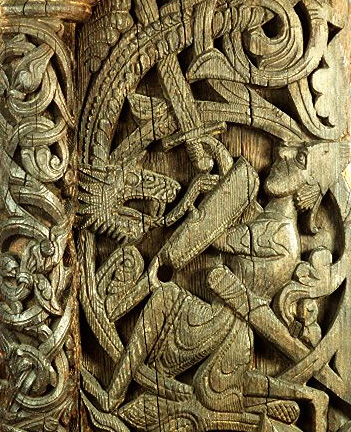
It is on the portals of these stave churches that we not only find depictions of dragons, but of Fafnir specially. In this detail from a portal that was originally in the Hylestad Stave Church there is a clear depiction of Sigurd slaying Fafnir. Every church goer in Medieval Norway would pass these carvings and be reminded of the old pre-Christian myths.
Norway became officially converted in 1024, it is therefore important to note that these stave churches date much later. The earliest is dated to around 1130, over one hundred years later. The dragon imagery and myths remained essential to the Medieval Norwegians for hundreds of years after their Christian conversion. It is hard to say why these stories became and remained such an integral part of the Christian churches. It is possible that they began to merge with the Christian teachings and that the Christian neophytes found no contradiction between these two philosophies. It has also been suggested that they remained for political reasons since Sigurd (the dragon slayer) was believed to be a progenitor of the kings of Norway.
These churches are important because they offer a visual record of stories that were vital to the earlier Scandinavians and also throughout Northern Europe as indicated by the presence of these myths in the Beowulf epic. Additionally, the relevancy of these Medieval stave church portals can also be seen today in movie theaters across the world right now in The Hobbit trilogy.
Bonus: While Smaug the Magnificent is having his moment on the big screen he had better be careful whilst enkindling Laketown, for some of those dragon carvings on the gables of those Scandinavian Medieval-inspired buildings may very well be harking back to his own father.
*There are other dragon figures in Middle Earth and some do bear more of a resemblance to Beowulf's bane - such as Scatha. However, we are focusing on the influences for Smaug in particular.
.
The celebrated creator of Middle Earth, J.R.R. Tolkien, was a scholar of Northern or Norse mythology. As such, he was familiar with what he would call the two great dragons of North mythology: Beowulf's bane and Fafnir from the Volsung Saga. He is noted as having said in his essay "Beowulf: The Monsters and the Critics" that there were only two important dragons in European literature, "Fafnir, and Beowulf's bane." Tolkien certainly used both of these as influences for his dragon episode in "The Hobbit."*
Tolkien seems to have used the story of dragon in Beowulf as inspiration for his dragon episode in The Hobbit more than the dragon's personality. For example, in Beowulf, the dragon claims treasure that was originally owned by another group and guards it for three hundred years before being disturbed by a thief who steals one golden cup. The dragon is enraged and lashes out at the surrounding countryside until Beowulf decides to confront him. Beowulf arrives at the dragon's lair with eleven of his fine fighting Geats accompanied by the thief. In front of the lair Beowulf makes a speech (reminiscent of Peter Jackson's Thorin) and the battle ensues, however it is not the hero of the story or the thief that eventually slays the dragon but another character of the story called Wiglaf. These are just some of the striking parallels between Beowulf and The Hobbit narratives; the original scene is complicated and worth reading. You can find John Lesslie Hall's translation free online here.
The character of Smaug seems to be more heavily influenced by the dragon of the Volsung Saga, Fafnir. The most notable similarity that they share in contrast to Beowulf's dragon is their intellect. Beowulf's dragon is a fire breathing monster, a menace to be sure, but not something to be reasoned with much less a subject for confabulation. Whereas, for Smaug and Fafnir, some of the best moments of the story are when they are in dialogue with the protagonists. The first thing that Fafnir says in the story is, "Who art thou? And who is thy father?" One of the first things that Smaug says to Bilbo is, "Who are you and where do you come from, may I ask?” They are inquisitive and intellectual, an absence in Beowulf's bane. In fact, that he is known as "Beowulf's bane" with no name to himself is notable. Beowulf's unnamed dragon plays the role of an antagonist as a beast of brute strength. Though Smaug and Fafnir can both claim physical magnificence as well, they are both also intellectual opponents to their respective slayers. It can perhaps be said that characteristically Smaug is a descendant of Fafnir.
Not only is he a literary descendant, but Fafnir is a predecessor to Beowulf's bane. In the Beowulf epic, Beowulf de-arms the Grendel to the delight of the Danes. In their celebration, the Danish people begin to recount earlier tales of glory. The tale they choose to recount is from the Volsung Saga:
Though the roles are reversed in the Danes' version of the story (in the Volsung Saga it is Sigurd who kills the dragon not his father Sigmund), it is the same dragon who is object of heroic violence, Fafnir. This story is thought to be told as a foreshadowing of Beowulf's solo encounter with the dragon and his consequential doom.Of Sigemund grew,when he passed from life, no little praise;for the doughty-in-combat a dragon killedthat herded the hoard: under hoary rockthe atheling dared the deed alonefearful quest, nor was Fitela there.Yet so it befell, his falchion piercedthat wondrous worm,—on the wall it struck,best blade; the dragon died in its blood.
 |
| Borgund Stave Church ca. 1180 |
Christianity flowed through Norway in the tenth and eleventh centuries beginning with missionaries and then courtesy of the controversial King Olaf Tryggvason whose motives and history are of an obfuscatory nature at times. Culminating in King Olaf II (who became St. Olaf) and his promulgation of mandatory Christianity at the Moster Council in 1024. Wooden churches were built as a result of the conversion. These churches are known as stave churches due to their unique construction technique. While there were thought to be as many as one to two thousand of these churches in Norway at one time, approximately only thirty remain. One thing that these remaining churches have in common with each other is their prominent dragon imagery. The dragon heads that once decorated Viking ships (such as the one found at Oseberg) became featured on the gables of the Christian church. Additionally, dragon imagery has an even more intimate place on these churches - the portals.
 |
| Detail from Hylestad Stave Church portal ca. late 12th -early13th c. |
It is on the portals of these stave churches that we not only find depictions of dragons, but of Fafnir specially. In this detail from a portal that was originally in the Hylestad Stave Church there is a clear depiction of Sigurd slaying Fafnir. Every church goer in Medieval Norway would pass these carvings and be reminded of the old pre-Christian myths.
Norway became officially converted in 1024, it is therefore important to note that these stave churches date much later. The earliest is dated to around 1130, over one hundred years later. The dragon imagery and myths remained essential to the Medieval Norwegians for hundreds of years after their Christian conversion. It is hard to say why these stories became and remained such an integral part of the Christian churches. It is possible that they began to merge with the Christian teachings and that the Christian neophytes found no contradiction between these two philosophies. It has also been suggested that they remained for political reasons since Sigurd (the dragon slayer) was believed to be a progenitor of the kings of Norway.
These churches are important because they offer a visual record of stories that were vital to the earlier Scandinavians and also throughout Northern Europe as indicated by the presence of these myths in the Beowulf epic. Additionally, the relevancy of these Medieval stave church portals can also be seen today in movie theaters across the world right now in The Hobbit trilogy.
Bonus: While Smaug the Magnificent is having his moment on the big screen he had better be careful whilst enkindling Laketown, for some of those dragon carvings on the gables of those Scandinavian Medieval-inspired buildings may very well be harking back to his own father.
 |
| Still of Lake Town from "The Hobbit: Desolation of Smaug" |
*There are other dragon figures in Middle Earth and some do bear more of a resemblance to Beowulf's bane - such as Scatha. However, we are focusing on the influences for Smaug in particular.
.
Saturday, October 5, 2013
The Calling of Art According to Goethe
 I recently picked up a book purely for the title: Goethe on Art. Who better, I thought, to guide me through the intriguing world of German Romantic art than he? Goethe was an author (among many other things) who was an early figure in the Romantic movement as it came to fruition in Germany. This book, as I was soon to learn from the inside flap, was the first English edition of Goethe's writings on art since 1845. Gold. The volume is a collection of letters, essays, reviews, and articles by Goethe on the subject of art; edited and translated by John Gage, lecturer of art history at the University of Cambridge.
Goethe was always interested in art, famously saying: "I have lived among painters and learned, like them, to look at objects with the eye of an artist...The eye was the organ par excellence, through which I apprehended the world." He founded two art periodicals, ran a series of painting competitions. He drew often himself, and we have many of sketches still today.
John Gage primarily chose writings that dealt specifically with art criticism. It was for this reason that I was especially interested: I thought I could gain some insight into a brilliant yet non-philosopher's mind on questions such as "what is art" or "what is beauty." He does not address these questions directly, but he does offer some insight into what he thinks is important in a work of art. For example, here is what he had to say in his rather stark comparison of Rembrandt and Raphael:
"When Rembrandt presents his Madonna and Child as a Dutch farmer's wife, any little critic can see that this goes quite contrary to history, which relates how Christ was born in Bethlehem, in the land of the Jews. 'The Italians have done it far better,' says he. But how? Did Raphael paint anything more, or other, than a loving mother with her first and only child? And was there anything else to be extracted from the subject? And has not motherly love in all its nuances been a rich source of material for poets and painters in all periods? But all the simplicity and truth has been taken out of the Bible stories by the attempt to ennoble them and adapt them to the rigid decorum of the church; they no longer hold the sympathy of the heart, but dazzle the blunted sense. Mary now sits between the curlicues of a tabernacle, as if she was exhibiting her child to the shepherds for money, or perhaps she has been using the enforced idleness of childbed to make herself beautiful for the honour of this visit. That fits; that is appropriate; that does not conflict with history! How does Rembrandt deal with this objection? He takes us into a dark stable which want has forced the mother, with her child at her breast, to share with the cattle. They are both buried up to the neck in straw and clothing, everything is dark except a lamp which lights up the father, sitting with a little book from which he seems to be reading some prayers to Mary. At that moment, the shepherds come in. The first, carrying a lantern, peers into the straw as he takes off his hat: could the question 'Is this the new-born King of the Jews?' ever be more clearly expressed?"Goethe is impressed with how Rembrandt illuminates the "truth and simplicity" of the historical and religious event without giving too much priority to religion or history. Truth seems to be what is important to Goethe, or at least his version of it. Not only does he speak of retaining the simple truth of Jesus' birth, but also in other scenes such as landscapes. One painter he particularly thought skilled at this was (no surprise, perhaps) Caspar David Friedrich. In speaking of some sepia drawings by Herr Friedrich:
"[Friedrich] is an artist who holds fast to nature with earnestness and truth, who unfolds his inner self in his works, and strives towards significance, who, in a word, unites the particularity of the general idea with a characteristic rendering of the individual parts, this artist can never lack the support of the public, for he brings new things to light, and, at the same time, has the quiet reward of being right. But even those who are accustomed to making higher demands must praise him, for the endeavour to strike out an individual path itself demands no ordinary courage and talent, and since already in the simple, characteristic, true imitation of Nature an appreciable level of art is attained, there is no reason why the old and tried rules should not be strictly observed."Goethe doesn't stop there though, he goes on to speak of a truth that is beyond the physical world. A 'true ideal' in which an artist could idealize a landscape in order to achieve a higher truth. In speaking of a collection of Claude's landscapes:
"Here for once you see a complete man, who thought and felt beauty, and in whose mind there was a world such as you will not find outside of it. The pictures are true, yet have no trace of actuality. Claude Lorrain knew the real world by heart, down to the minutest details, but he used it only as the means of expressing the world of his beautiful soul. That is the true ideal, which can so use real means of expression that the truth which emerges gives the illusion of actuality."I thought a key phrase here was, "the truth which emerges gives the illusion of actuality." He is essentially saying that Claude is able to find beauty and then present it to those who look upon his work in a way that we can understand.This falls in line more with the Romantic notion of genius and inspiration.
The written works of this volume are primarily Goethe's thoughts on different works of art from a technical perspective. Sprinkled throughout, however, are little nuggets that help one to see more clearly what Goethe thought was important in art. He thought it was truth. Though I'm not sure what that meant exactly to him from these particular writings, I can't say that's a bad starting place.
Thursday, August 1, 2013
Fictional Sculpture
What a great murky depth of the human experience is fiction. At once it pokes, prods, and otherwise disturbs common conceptions of truth while at the same time being one of truth's greatest promoters. After all, is not the very definition of fiction something that didn't actually happen? How then has it been allowed to exist for so long pervading every aspect of life, if it is essentially a lie? For many reasons, of course, but not the least of which is the fact that it is a proven method for demonstrating truth. To say a story didn't actually happen is only to say that it is not grounded in historical truth, but historical truth is only one kind of truth. Oscar Wilde once said that a man needs a mask to tell the truth: perhaps we may also say that stories need a mask to tell the truth as well. Let us say that history is a story that tells us the 'what,' and fiction is a story that tells us 'why.' It is hard to reconcile these together without sacrificing the integrity of one or the other.
The way fiction tells us truth is through the use of layers. Looked at very simply, stories have two basic layers: the plot or narrative and an underlying philosophy or moral. Though sometimes more intentional than others, all stories have both of these things. The value of the 'story' layer is determined by its entertainment, ability to captivate the reader, and believability while the value of the 'philosophy' layer is determined by its trustworthiness and enlightenment. Some stories are more successful at one layer than the other, but they are always both there. Generally speaking, when a volume becomes a classic it is because both layers are considered successful.
Even stories that are highly fantastical and imaginative demonstrate truth to the reader. This is another power of fiction. If a random person stops you on the street to tell you that they saw an elf or dragon it is unlikely that you would believe it. However, if Tolkien, in the comfort of a piece of fiction tells you there are elves or dragons in Middle Earth it much easier to believe. What truth can be derived from such incredible fairy tales? In Tremendous Trifles, Chesterton tells us that children don't need fairy tales to tell them of 'bogeys,' these they know of from the time they have an imagination. They need fairy tales to show them that the 'bogeys' can be defeated. Additionally, in Orthodoxy he tells us that fairy tales are more than ethical or life lessons, they are needed to remind us that the world we actually live in is itself magical. Fantastical and imaginary worlds show us how our world might have been and that it is magical the way it is: as full of surprises and unpredictability as any Shire, Gotham, or Wonderland.
I submit that this is true of sculpture as well. Sculpture is fiction - a two layered story. The way the sculpture appears is the 'story' layer and whatever meaning it has is the 'philosophy' layer. On the surface, a sculpture is successful based on its visual appeal (not necessarily prettiness) and its ability to captivate the imagination. The underlying layer tells a truth. Just like fiction in literary form, sculpture may emphasize one of these layers more than the other. Some pieces are created merely to make a statement, but that does not release it from the responsibility to try and attract the eye whether it be with aesthetic appeal or some kind of 'shock factor.' Conversely, some sculpture may primarily intend to please the eye. However, a piece cannot intend to please the eye without an underlying concept of what is pleasing to the eye, or making a statement about beauty in general.
My principle reason for demonstrating the parallel between fiction in literary form and in sculpture form is to offer a helpful way to look at sculpture - but specifically abstract sculpture. I fear that there is a temptation to try and 'get' abstract sculpture. As if classical sculptures are just for the looks and that modern sculpture is just for making a statement. This is a false dichotomy. Both classical sculpture and modern/abstract sculpture are multi-layered fictions.
This is more obvious in pieces such as Lacoon and Sons. This piece not only tells a story, but it does so in a visually striking way. The emotion and action exhibited here are undeniably captivating. Because this piece is from a story, the underlying philosophy is fairly evident. This piece depicts a scene of truth, sacrifice, and tragedy. Does this depiction of human mortality and divine intervention arouse sympathy? Is there beauty in a martyr for truth? These questions are the ones that arise from the underlying layer of meaning.
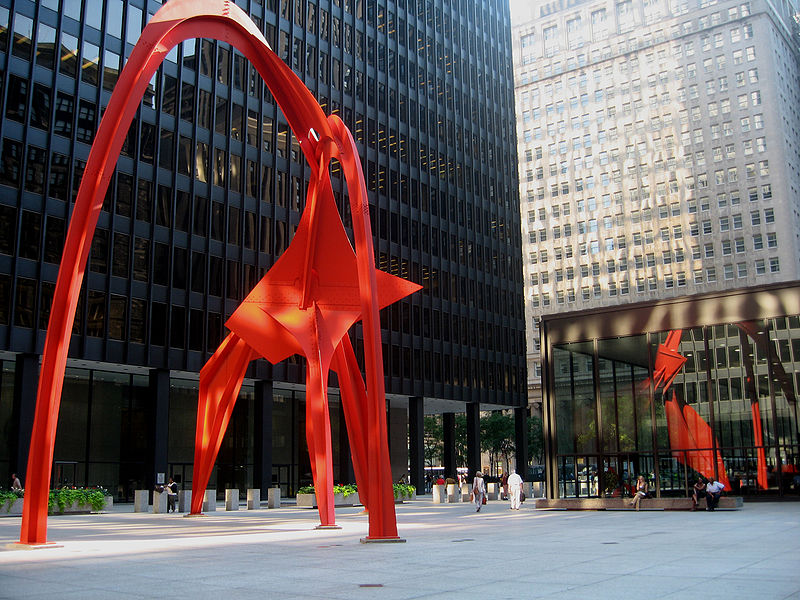
For my abstract example, I have chosen one of my favorites: Alexander Calder's Flamingo. Since this piece does readily represent something we are familiar with, it is tempting for an initial response to be something like, "what does it mean?" Calder once said that the model for his sculptures was the Universe itself. The way that different forms and densities interacted, some in movement some static. He explored the disparity of shape, movement, and form. To him, the Universe is an abstract combination of wild and wonderful things. This sculpture is like one of Chesterton's fairy tales, it reminds us that this is a world of surprises and unpredictability. However, whatever this sculpture 'means' or represents there is still a strong 'story' layer. While this piece might not seem 'pretty' it is certainly striking and fun to look at. Its placement among the dark, square skyscrapers makes it even more striking as it contrasts them with bright color and a playful shape. Any viewer can enjoy this piece without once thinking of its deeper meaning.
Like literary fiction, sculpture fiction is multi-layered. Yes, the pieces have meaning of varying success, but it is a form of self-deprivation to miss the joy and fun of sculpture by looking at a piece only through the lens of metaphysical scrutiny. The deeper meaning will come more naturally if it is engaged on a more simple level of whether or not it is nice to look at. To read A Tale of Two Cities only to look for the symbolism and social commentary is to miss out on Dickens' masterful storytelling, character development, and humor. The same goes with sculpture: enjoy it without the pressure of deeper meaning, and consequently it will be easier to 'understand.'
The way fiction tells us truth is through the use of layers. Looked at very simply, stories have two basic layers: the plot or narrative and an underlying philosophy or moral. Though sometimes more intentional than others, all stories have both of these things. The value of the 'story' layer is determined by its entertainment, ability to captivate the reader, and believability while the value of the 'philosophy' layer is determined by its trustworthiness and enlightenment. Some stories are more successful at one layer than the other, but they are always both there. Generally speaking, when a volume becomes a classic it is because both layers are considered successful.
Even stories that are highly fantastical and imaginative demonstrate truth to the reader. This is another power of fiction. If a random person stops you on the street to tell you that they saw an elf or dragon it is unlikely that you would believe it. However, if Tolkien, in the comfort of a piece of fiction tells you there are elves or dragons in Middle Earth it much easier to believe. What truth can be derived from such incredible fairy tales? In Tremendous Trifles, Chesterton tells us that children don't need fairy tales to tell them of 'bogeys,' these they know of from the time they have an imagination. They need fairy tales to show them that the 'bogeys' can be defeated. Additionally, in Orthodoxy he tells us that fairy tales are more than ethical or life lessons, they are needed to remind us that the world we actually live in is itself magical. Fantastical and imaginary worlds show us how our world might have been and that it is magical the way it is: as full of surprises and unpredictability as any Shire, Gotham, or Wonderland.
I submit that this is true of sculpture as well. Sculpture is fiction - a two layered story. The way the sculpture appears is the 'story' layer and whatever meaning it has is the 'philosophy' layer. On the surface, a sculpture is successful based on its visual appeal (not necessarily prettiness) and its ability to captivate the imagination. The underlying layer tells a truth. Just like fiction in literary form, sculpture may emphasize one of these layers more than the other. Some pieces are created merely to make a statement, but that does not release it from the responsibility to try and attract the eye whether it be with aesthetic appeal or some kind of 'shock factor.' Conversely, some sculpture may primarily intend to please the eye. However, a piece cannot intend to please the eye without an underlying concept of what is pleasing to the eye, or making a statement about beauty in general.
My principle reason for demonstrating the parallel between fiction in literary form and in sculpture form is to offer a helpful way to look at sculpture - but specifically abstract sculpture. I fear that there is a temptation to try and 'get' abstract sculpture. As if classical sculptures are just for the looks and that modern sculpture is just for making a statement. This is a false dichotomy. Both classical sculpture and modern/abstract sculpture are multi-layered fictions.
 | ||||||
|
This is more obvious in pieces such as Lacoon and Sons. This piece not only tells a story, but it does so in a visually striking way. The emotion and action exhibited here are undeniably captivating. Because this piece is from a story, the underlying philosophy is fairly evident. This piece depicts a scene of truth, sacrifice, and tragedy. Does this depiction of human mortality and divine intervention arouse sympathy? Is there beauty in a martyr for truth? These questions are the ones that arise from the underlying layer of meaning.
 | ||||||||||
|
For my abstract example, I have chosen one of my favorites: Alexander Calder's Flamingo. Since this piece does readily represent something we are familiar with, it is tempting for an initial response to be something like, "what does it mean?" Calder once said that the model for his sculptures was the Universe itself. The way that different forms and densities interacted, some in movement some static. He explored the disparity of shape, movement, and form. To him, the Universe is an abstract combination of wild and wonderful things. This sculpture is like one of Chesterton's fairy tales, it reminds us that this is a world of surprises and unpredictability. However, whatever this sculpture 'means' or represents there is still a strong 'story' layer. While this piece might not seem 'pretty' it is certainly striking and fun to look at. Its placement among the dark, square skyscrapers makes it even more striking as it contrasts them with bright color and a playful shape. Any viewer can enjoy this piece without once thinking of its deeper meaning.
Like literary fiction, sculpture fiction is multi-layered. Yes, the pieces have meaning of varying success, but it is a form of self-deprivation to miss the joy and fun of sculpture by looking at a piece only through the lens of metaphysical scrutiny. The deeper meaning will come more naturally if it is engaged on a more simple level of whether or not it is nice to look at. To read A Tale of Two Cities only to look for the symbolism and social commentary is to miss out on Dickens' masterful storytelling, character development, and humor. The same goes with sculpture: enjoy it without the pressure of deeper meaning, and consequently it will be easier to 'understand.'
Wednesday, May 29, 2013
The Eye of the Beholder
It was the fourth century, and a newly ordained priest called John had just begun to offer his first sacrifice of the mass. However, he was so overcome with a feeling of unworthiness that he shed his ecclesiastical robes and fled into the wilderness instead. In the rocky wilderness he embraced the ascetic life, spending much time in prayer and meditations. One day, a princess from a nearby kingdom was whisked to his cave by a magical wind. Fearing that she was an agent of Satan, he refused her entry. Eventually, she was able to satisfactorily convince him that she was not from hell. Despite this, fearing sensual temptation, he drew a line down the middle of the cave and stated that she could remain in the cave on the condition that she stay on the opposite of the line from himself. Apparently the line was not enough to inhibit the most primal urge of humankind, and in one lubricious moment he crossed the line and gave into his passions. They both immediately plunged into contrite repentance. Overcome with grief, the priest, fearing further sin, carried her off and cast her off of a cliff. Again, he realized the error of this action and fled to the pope begging for absolution. When the pope denied it, the priest vowed to crawl on his hands and knees until he could be forgiven. Fifteen years later, a queen had a child. For the christening feast a huntsman went into the forest, happening upon a strange beast, he captured it and brought it back to the queen. Meanwhile, the child was to be baptized. However, the child refused to be baptized and spoke up in an unnatural voice that he would, "only be baptized by John." Just at this moment, the huntsman had brought the strange beast forward to present to the queen. The beast, upon hearing the child speak, slowly looked up. The beast was, of course, John.
This is one part of one of the many extraordinary legends that surrounds early church father John Chrysostom. However, this little slice of hagiography is extremely unlikely to contain much more than the smallest kernel of truth. Regardless, it became the subject matter for a piece by Italian painter Mattia Preti. This eye-catching oil on canvas piece measures an ample 96" x 75." Painted in 1640, the work shows John Chrysostom on all fours in the foreground. Behind him stands the huntsman, opposite him are the queen holding the child, an unidentified child, and a hunting dog. This chiaroscuro scene is set in front of a classical background, though the characters are all appareled with clothing contemporary to the artist. In the triangular foreground the rich colors of the garments are a stark contrast to the olive colored, emaciated figure of John.

I recently spent a long time in front of this work, and it spawned many fascinating avenues of thought that I happily traveled down. But the most interesting thing about this painting was the ambivalence that Preti has created regarding John's spiritual status. The temptation that he had given into in the cave was a young woman of royalty, and here in front of him stands a beautiful young queen. In her fashionable and subtly seductive clothing she is the very picture of his original mistake. Between him and the lady, however, is the child. The child is a not so subtle representation of the Christ Child, reaching out his hand in forgiveness. The question that I tried to answer while looking at this work is this: what is John looking at? Is it the child or the queen? After all those years of penitence is he still in the grip of temptation and lust? Or has his contrition become complete? Repentance or relapse?
Additionally, Preti shows a progression that starts with the hound and goes to the huntsman. The dog represents the carnal primal urges, the child in front of the dog represents a childish curiosity. Two things that caused John to end up in his current position. Both the dog and the child are facing away from the queen and child. The ragged, destitute, and anemic John is the symbol of one who has fallen to lust. Though there may be indecision on his part, he looks up from his depravity to the one who can pardon him. The hopeful future is represented in the dark background by the well-dressed, healthy, huntsman bows his head humbly to the child. The huntsman is a shadow of what John can become if pardoned; however, should John fall to temptation again the chain is ready to pull him into the pit. A story of redemption in one frame. Preti displays in this painting consequences of past mistakes and potential mistakes - but also the possibility of restoration.
This is one part of one of the many extraordinary legends that surrounds early church father John Chrysostom. However, this little slice of hagiography is extremely unlikely to contain much more than the smallest kernel of truth. Regardless, it became the subject matter for a piece by Italian painter Mattia Preti. This eye-catching oil on canvas piece measures an ample 96" x 75." Painted in 1640, the work shows John Chrysostom on all fours in the foreground. Behind him stands the huntsman, opposite him are the queen holding the child, an unidentified child, and a hunting dog. This chiaroscuro scene is set in front of a classical background, though the characters are all appareled with clothing contemporary to the artist. In the triangular foreground the rich colors of the garments are a stark contrast to the olive colored, emaciated figure of John.

I recently spent a long time in front of this work, and it spawned many fascinating avenues of thought that I happily traveled down. But the most interesting thing about this painting was the ambivalence that Preti has created regarding John's spiritual status. The temptation that he had given into in the cave was a young woman of royalty, and here in front of him stands a beautiful young queen. In her fashionable and subtly seductive clothing she is the very picture of his original mistake. Between him and the lady, however, is the child. The child is a not so subtle representation of the Christ Child, reaching out his hand in forgiveness. The question that I tried to answer while looking at this work is this: what is John looking at? Is it the child or the queen? After all those years of penitence is he still in the grip of temptation and lust? Or has his contrition become complete? Repentance or relapse?
Additionally, Preti shows a progression that starts with the hound and goes to the huntsman. The dog represents the carnal primal urges, the child in front of the dog represents a childish curiosity. Two things that caused John to end up in his current position. Both the dog and the child are facing away from the queen and child. The ragged, destitute, and anemic John is the symbol of one who has fallen to lust. Though there may be indecision on his part, he looks up from his depravity to the one who can pardon him. The hopeful future is represented in the dark background by the well-dressed, healthy, huntsman bows his head humbly to the child. The huntsman is a shadow of what John can become if pardoned; however, should John fall to temptation again the chain is ready to pull him into the pit. A story of redemption in one frame. Preti displays in this painting consequences of past mistakes and potential mistakes - but also the possibility of restoration.
Saturday, April 27, 2013
We Cannot Climb by Night: Part 2
I recently spent some time experiencing the paintings in
Nikki Toyama's show called Edifice. Her show is about the
interaction of light and architecture in an urban setting. The show starts out
with a work called Into the Mission which I wrote about here.
At the end of the show is another painting called Driving to
Tabernacle. These are the biggest two paintings, and are arranged in a
way that you can encounter them individually and then side by side.
It was while I absorbed these two paintings simultaneously that I
began to notice complementary contrasts between them which helped me to approach them
each on their own again. These two paintings show the contrasting forces of
light and architecture working with and against each other. They show how
light, so ephemeral and transparent, can wield a power over the sturdy solidity
of the buildings. Nikki shows this power by showing the movement of light.
Movement that is simultaneously evanescent and lasting, powerful and delicate,
blinding and illuminating.
 |
The road slopes away from the center of itself,
the light that streams onto the road seems to function as motion lines. The
upper surface has strong lines that follow the movement of the vehicles and
tilts in such a way that we feel rapid movement through the tunnel. The
vehicles move forward and are enveloped in the light, almost as if in just a
few more moments they will disappear from sight. Interestingly, the
painting is able to make the viewer part of the scene. There are two somewhat
subtle vertical lines in the painting. One in the bottom left of the painting
and the other on the right wall at the very end of the tunnel. These two lines
parallel each other, but they are not completely vertical. The one on
the right is part of the tunnel's structure, but the one in the bottom left is
not obviously recognizable. It serves to help frame the picture in such a way
that pulls the viewer forward and into the picture. The red of the taillights
stand out against the black and white in one of the only colored
parts of the picture. The only other colorful part of the painting is the warm
yellow glow of the doors lining the street in the background.


The painting pulls the viewer in
because of the vortex of bright white light.
It simultaneously streams into the tunnel and pulls you out of it
into the open. This painting is not static; it moves and moves the eye. Like Into
the Mission, this painting has two components. Unlike Into
the Mission, which had two separate fields and energies,
both of the two components run together seamlessly. The first
section is the actual tunnel. The tunnel is the feature that the artist uses to
show the interaction of building and light. The tunnel takes up most of the painting;
it dominates the foreground, and is the largest subject in the work. Large and
dominating as it is, the tunnel gives way to the light. In fact the tunnel
serves the light. The only function of the tunnel is to show the light. If
there was no tunnel, the painting would be blinding, all that would be there
was a piercing white light. However, with the tunnel the light
is able to reveal itself without getting lost. The light and the building are
dependent upon each other in this work. Without the light, you could not see
the tunnel and without the tunnel you could not see the light.
This work is all about forward movement. The
viewer is moving through a tunnel, the cars ahead are moving forward, the light
draws the eye into an indiscernible distance. The fact that the doors are the only thing visible in the background seems to indicate movement also: one portal leading to another. What does this movement of
light against the cold tunnel mean? The interplay could be making a
metaphysical or existential statement, just think of how many metaphors a
tunnel can be used for. This could represent death, or progress, or even time.
Of course the painting could also be a capture of a moment in time, not to
mention the possibility that it's both. The key to this lies in seeing this
together with Into the Mission. The stillness of those two
cars heading to the mission explodes into action here. They speed ahead; even
the tunnel can't hold them for long. They now have the light they require to move, and move they do.
Saturday, April 13, 2013
We Cannot Climb by Night: Part 1
I recently had the pleasure of experiencing Nikki Toyama's exhibit called Edifice. In the show are a series of paintings that explore the interaction of light and architecture. In her manifesto she says:
"Man's power is signified through the construction of the metropolis. Simultaneously, light continues to make its steady impression on man's work. The city, represented in these 'unshakable' forms made by man, dissipates underneath the natural forms of light."She shows how light 'has its way' with the buildings by accentuating the contrast between the dark, static nature of the architecture and light's ability to create movement and life. In fact, it is the movement of light that gives it its power. The two largest of the paintings of the show were displayed in such a way that at the correct angle you could see them both side by side, though they were on different walls. I can't help but to assume this was intentional, and if it was, I thought this installation choice was successful. It gave me the chance to see both paintings individually, and then as I moved through the exhibit I saw them again, only this time side by side. Alone they spoke clearly, but together their voices spoke an even stronger message of the power of light.


This painting has two portions. The first is the sky. The sky is filled with movement, the vertical lines and faint shadows of other buildings in the background give the whole upper part of the painting a shimmering, almost radiant appeal. Even though the buildings are flat and square, from left to right they gradually lead up into an apex that fades into the light. The shape of the skyline, the shimmering light, and the faint glimpses of pointed roofs (steeples?) in the distance give the whole sky a near transcendental aura. The reason it seems transcendental is simply the fact that the movement all points upwards. The emphasis of the sky is not depth, but movement.
Everything changes on the bottom half. There is plenty of depth, but no movement. Stillness. The two cars sit on the flat road with their lights off, the fact they aren't going anywhere seems exemplified by the ghost signs which are erased of any destination. The support railing for the road signs is in the shape of a fence, barring any progress. Even if the cars were to move forward, the only thing ahead of them on the road is just another underpass. The stillness of the road is defined by the darkness. In fact, the darkness is the reason for the stillness, below those road signs are only shadow and dimness. The darkness in the lower half of the painting chokes the life from it...shown by the lifeless, leafless shrub.
The painting employs a rather prosaic scene, driving into the city, to reveal its truth. In reality, one might think that it would be the bottom half of the scene that would be the busy one. The road would be filled with moving cars, which would be filled with moving people. Each underpass would only be seen for a few moments (barring traffic) and the signs would confidently present your destination. The lights that would be the most obvious would be the lights of the car in front and beside you. The sky would be motionless. In fact, the high rise buildings would stand so tall and proud that the sky itself would be reduced to some kind of super sized wallpaper upon which the city skyline can present itself. The painting completely inverts this. The sky holds the force of movement and becomes the sole conduit of light, and the city below has no choice but to submit. The painting does not contradict the reality, but instead enhances it by showing the power, necessity, and beauty of the light.
In Dante's Purgatorio*, all the souls have one task: to constantly move upwards in their purging journey towards God. Being in purgatory is no great joy and they all want to move through as quickly as possible, however, after nightfall everyone immediately stops moving. Curious,Virgil asks why this is, and the guide says, "We cannot climb by night." He explains that anyone of them could continue walking all night, but without the light which represents God's grace, it would be impossible to make progress. Because of the darkness they would lose their way and end up never taking even one step forward. Therefore, they must wait until morning to travel again. It is darkness alone that hinders Dante's travelers, and I think that it is darkness that hinders those two cars. Though their intentions are benevolent, as indicated by the painting's title; the shimmering, lively light in the sky must descend on the road for them to continue onto their work. One might speculate a little further and say that not only must they wait for the light, it is the light that gives their work purpose at all.
*Canto VII lines 40-63
Wednesday, March 20, 2013
Atrium With a View

In his recent visit to Harvard's Graduate School of Design, well established architect John C Portman shared some of his "advice and wisdom." His signature work is the Hyatt hotel in Atlanta, GA built in 1967. When it opened it was a massive success for himself and the city. In describing it Portman said, "From my office I can go all the way to Frankfurt, Germany, without putting on a coat, or getting wet." Early visitor and Atlanta native Andrew Young remembered it this way in his documentary John Portman: A Life of Building:
"Its neck-craning, 22-story atrium was a completely new idea. Everyone became a country bumpkin when they walked into the Hyatt, you had to say: Oh, my God, what is this?”In speaking of his work, Portman calls himself a humanitarian explaining that his works are about the people more than the "things." However, he takes his vision even further:
“I’m interested in taking the physical world and the individual, spiritual world together,” he said — a holistic vision of architecture that depends as much on Emerson and Toynbee as it does on engineering. “I would like to reset how we look at architecture.”

It is a bold thing to want to reset architecture, but had anything like this been done before? I think that it is interesting that he refers to Frankfurt for there resides the St Bartholomew Cathedral. This structure was built in the 14th and 15th centuries on the site of an even earlier church from the 12th century. The impressively tall tower has caused it to be dubbed "Frankfurt's first skyscraper." When this was built during the time of the Holy Roman Empire, this massive structure would have had the same humbling effect on villagers who visited but multiplied many times over, possibly causing them to cry out to their God as well. It even has a viewing platform for the public at sixty-six meters.
This structure certainly brings the physical and spiritual worlds together, but in an ancient and orthodox method that long predates Emersonian metaphysics. The high vaulted ceilings inspired by the trees, and the magnificent windows allow the experience of the architecture to be merged with the natural world, but it goes further than that. The high vaulted ceilings draw the visitors eyes consistently upward towards the heavens. The tall stained glass portals of that shaded light enhances the experience of the worshiper and tries to bring them closer to God. In fact everything about the architecture draws the eyes upward.


Portman's impressive architectural victory indeed caused visitors to look upward in amazement at his fusion of natural elements into his building. Indeed, it wasn't long before Portman's designs became widely used and popular. However, long before Portman or Emerson, churches were fusing the natural, spiritual and architectural worlds in a way that still amazes and impresses and leads the eye ever upwards.
The article concerning Portman's visit Harvad's GSD can be found here.
Subscribe to:
Posts (Atom)