The celebrated creator of Middle Earth, J.R.R. Tolkien, was a scholar of Northern or Norse mythology. As such, he was familiar with what he would call the two great dragons of North mythology: Beowulf's bane and Fafnir from the Volsung Saga. He is noted as having said in his essay "Beowulf: The Monsters and the Critics" that there were only two important dragons in European literature, "Fafnir, and Beowulf's bane." Tolkien certainly used both of these as influences for his dragon episode in "The Hobbit."*
Tolkien seems to have used the story of dragon in Beowulf as inspiration for his dragon episode in The Hobbit more than the dragon's personality. For example, in Beowulf, the dragon claims treasure that was originally owned by another group and guards it for three hundred years before being disturbed by a thief who steals one golden cup. The dragon is enraged and lashes out at the surrounding countryside until Beowulf decides to confront him. Beowulf arrives at the dragon's lair with eleven of his fine fighting Geats accompanied by the thief. In front of the lair Beowulf makes a speech (reminiscent of Peter Jackson's Thorin) and the battle ensues, however it is not the hero of the story or the thief that eventually slays the dragon but another character of the story called Wiglaf. These are just some of the striking parallels between Beowulf and The Hobbit narratives; the original scene is complicated and worth reading. You can find John Lesslie Hall's translation free online here.
The character of Smaug seems to be more heavily influenced by the dragon of the Volsung Saga, Fafnir. The most notable similarity that they share in contrast to Beowulf's dragon is their intellect. Beowulf's dragon is a fire breathing monster, a menace to be sure, but not something to be reasoned with much less a subject for confabulation. Whereas, for Smaug and Fafnir, some of the best moments of the story are when they are in dialogue with the protagonists. The first thing that Fafnir says in the story is, "Who art thou? And who is thy father?" One of the first things that Smaug says to Bilbo is, "Who are you and where do you come from, may I ask?” They are inquisitive and intellectual, an absence in Beowulf's bane. In fact, that he is known as "Beowulf's bane" with no name to himself is notable. Beowulf's unnamed dragon plays the role of an antagonist as a beast of brute strength. Though Smaug and Fafnir can both claim physical magnificence as well, they are both also intellectual opponents to their respective slayers. It can perhaps be said that characteristically Smaug is a descendant of Fafnir.
Not only is he a literary descendant, but Fafnir is a predecessor to Beowulf's bane. In the Beowulf epic, Beowulf de-arms the Grendel to the delight of the Danes. In their celebration, the Danish people begin to recount earlier tales of glory. The tale they choose to recount is from the Volsung Saga:
Though the roles are reversed in the Danes' version of the story (in the Volsung Saga it is Sigurd who kills the dragon not his father Sigmund), it is the same dragon who is object of heroic violence, Fafnir. This story is thought to be told as a foreshadowing of Beowulf's solo encounter with the dragon and his consequential doom.Of Sigemund grew,when he passed from life, no little praise;for the doughty-in-combat a dragon killedthat herded the hoard: under hoary rockthe atheling dared the deed alonefearful quest, nor was Fitela there.Yet so it befell, his falchion piercedthat wondrous worm,—on the wall it struck,best blade; the dragon died in its blood.
 |
| Borgund Stave Church ca. 1180 |
Christianity flowed through Norway in the tenth and eleventh centuries beginning with missionaries and then courtesy of the controversial King Olaf Tryggvason whose motives and history are of an obfuscatory nature at times. Culminating in King Olaf II (who became St. Olaf) and his promulgation of mandatory Christianity at the Moster Council in 1024. Wooden churches were built as a result of the conversion. These churches are known as stave churches due to their unique construction technique. While there were thought to be as many as one to two thousand of these churches in Norway at one time, approximately only thirty remain. One thing that these remaining churches have in common with each other is their prominent dragon imagery. The dragon heads that once decorated Viking ships (such as the one found at Oseberg) became featured on the gables of the Christian church. Additionally, dragon imagery has an even more intimate place on these churches - the portals.
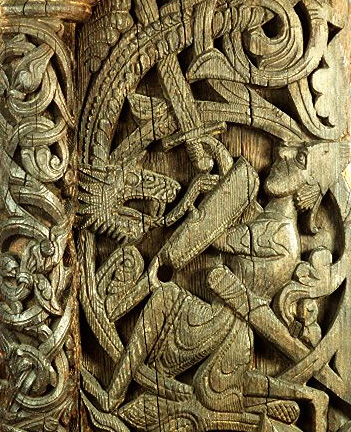 |
| Detail from Hylestad Stave Church portal ca. late 12th -early13th c. |
It is on the portals of these stave churches that we not only find depictions of dragons, but of Fafnir specially. In this detail from a portal that was originally in the Hylestad Stave Church there is a clear depiction of Sigurd slaying Fafnir. Every church goer in Medieval Norway would pass these carvings and be reminded of the old pre-Christian myths.
Norway became officially converted in 1024, it is therefore important to note that these stave churches date much later. The earliest is dated to around 1130, over one hundred years later. The dragon imagery and myths remained essential to the Medieval Norwegians for hundreds of years after their Christian conversion. It is hard to say why these stories became and remained such an integral part of the Christian churches. It is possible that they began to merge with the Christian teachings and that the Christian neophytes found no contradiction between these two philosophies. It has also been suggested that they remained for political reasons since Sigurd (the dragon slayer) was believed to be a progenitor of the kings of Norway.
These churches are important because they offer a visual record of stories that were vital to the earlier Scandinavians and also throughout Northern Europe as indicated by the presence of these myths in the Beowulf epic. Additionally, the relevancy of these Medieval stave church portals can also be seen today in movie theaters across the world right now in The Hobbit trilogy.
Bonus: While Smaug the Magnificent is having his moment on the big screen he had better be careful whilst enkindling Laketown, for some of those dragon carvings on the gables of those Scandinavian Medieval-inspired buildings may very well be harking back to his own father.
 |
| Still of Lake Town from "The Hobbit: Desolation of Smaug" |
*There are other dragon figures in Middle Earth and some do bear more of a resemblance to Beowulf's bane - such as Scatha. However, we are focusing on the influences for Smaug in particular.
.


