Thursday, August 1, 2013

Fictional Sculpture

     What a great murky depth of the human experience is fiction. At once it pokes, prods, and otherwise disturbs common conceptions of truth while at the same time being one of truth's greatest promoters. After all, is not the very definition of fiction something that didn't actually happen? How then has it been allowed to exist for so long pervading every aspect of life, if it is essentially a lie? For many reasons, of course, but not the least of which is the fact that it is a proven method for demonstrating truth. To say a story didn't actually happen is only to say that it is not grounded in historical truth, but historical truth is only one kind of truth. Oscar Wilde once said that a man needs a mask to tell the truth: perhaps we may also say that stories need a mask to tell the truth as well. Let us say that history is a story that tells us the 'what,' and fiction is a story that tells us 'why.' It is hard to reconcile these together without sacrificing the integrity of one or the other.

    The way fiction tells us truth is through the use of layers. Looked at very simply, stories have two basic layers: the plot or narrative and an underlying philosophy or moral. Though sometimes more intentional than others, all stories have both of these things. The value of the 'story' layer is determined by its entertainment,  ability to captivate the reader, and believability while the value of the 'philosophy' layer is determined by its trustworthiness and enlightenment. Some stories are more successful at one layer than the other, but they are always both there.  Generally speaking, when a volume becomes a classic it is because both layers are considered successful.

   Even stories that are highly fantastical and imaginative demonstrate truth to the reader. This is another power of fiction. If a random person stops you on the street to tell you that they saw an elf or dragon it is unlikely that you would believe it. However, if Tolkien, in the comfort of a piece of fiction tells you there are elves or dragons in Middle Earth it much easier to believe. What truth can be derived from such incredible fairy tales? In Tremendous Trifles, Chesterton tells us that children don't need fairy tales to tell them of 'bogeys,' these they know of from the time they have an imagination. They need fairy tales to show them that the 'bogeys' can be defeated. Additionally, in Orthodoxy he tells us that fairy tales are more than ethical or life lessons, they are needed to remind us that the world we actually live in is itself magical. Fantastical and imaginary worlds show us how our world might have been and that it is magical the way it is: as full of surprises and unpredictability as any Shire, Gotham, or Wonderland.

    I submit that this is true of sculpture as well. Sculpture is fiction - a two layered story. The way the sculpture appears is the 'story' layer and whatever meaning it has is the 'philosophy' layer. On the surface, a sculpture is successful based on its visual appeal (not necessarily prettiness) and its ability to captivate the imagination. The underlying layer tells a truth. Just like fiction in literary form, sculpture may emphasize one of these layers more than the other. Some pieces are created merely to make a statement, but that does not release it from the responsibility to try and attract the eye whether it be with aesthetic appeal or some kind of 'shock factor.' Conversely, some sculpture may primarily intend to please the eye. However, a piece cannot intend to please the eye without an underlying concept of what is pleasing to the eye, or making a statement about beauty in general.

     My principle reason for demonstrating the parallel between fiction in literary form and in sculpture form is to offer a helpful way to look at sculpture - but specifically abstract sculpture. I fear that there is a temptation to try and 'get' abstract sculpture. As if classical sculptures are just for the looks and that modern sculpture is just for making a statement. This is a false dichotomy. Both classical sculpture and modern/abstract sculpture are multi-layered fictions.
Yearc. 25 BC
TypeWhite marble
LocationVatican Museums, Vatican City


   This is more obvious in pieces such as Lacoon and Sons. This piece not only tells a story, but it does so in a visually striking way. The emotion and action exhibited here are undeniably captivating. Because this piece is from a story, the underlying philosophy is fairly evident. This piece depicts a scene of truth, sacrifice, and tragedy. Does this depiction of human mortality and divine intervention arouse sympathy? Is there beauty in a martyr for truth? These questions are the ones that arise from the underlying layer of meaning.
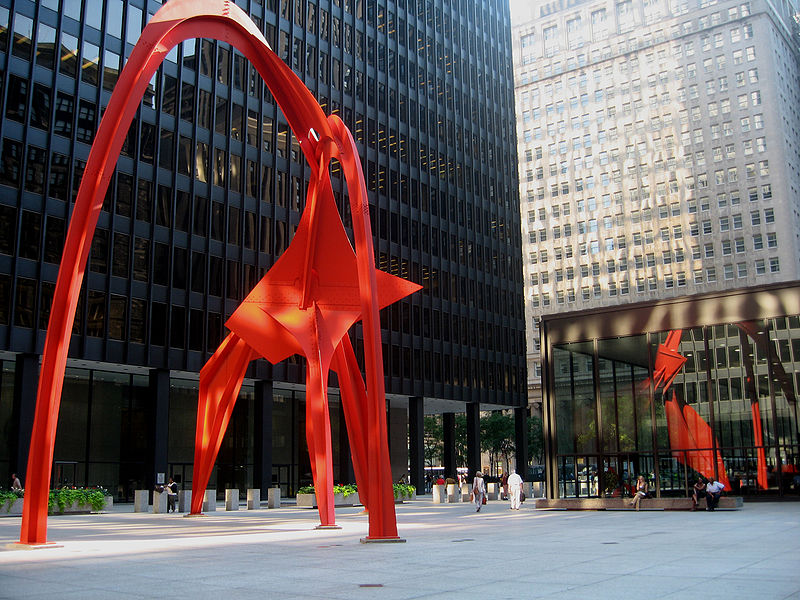


ArtistAlexander Calder
YearOctober 25, 1974
Typepainted steel stabile
Dimensions1,620 cm (636 in)
LocationChicago

For my abstract example, I have chosen one of my favorites: Alexander Calder's Flamingo. Since this piece does readily represent something we are familiar with, it is tempting for an initial response to be something like, "what does it mean?" Calder once said that the model for his sculptures was the Universe itself. The way that different forms and densities interacted, some in movement some static. He explored the disparity of shape, movement, and form. To him, the Universe is an abstract combination of wild and wonderful things. This sculpture is like one of Chesterton's fairy tales, it reminds us that this is a world of surprises and unpredictability. However, whatever this sculpture 'means' or represents there is still a strong 'story' layer. While this piece might not seem 'pretty' it is certainly striking and fun to look at. Its placement among the dark, square skyscrapers makes it even more striking as it contrasts them with bright color and a playful shape. Any viewer can enjoy this piece without once thinking of its deeper meaning.

     Like literary fiction, sculpture fiction is multi-layered. Yes, the pieces have meaning of varying success, but it is a form of self-deprivation to miss the joy and fun of sculpture by looking at a piece only through the lens of metaphysical scrutiny. The deeper meaning will come more naturally if it is engaged on a more simple level of whether or not it is nice to look at. To read A Tale of Two Cities only to look for the symbolism and social commentary is to miss out on Dickens' masterful storytelling, character development, and humor. The same goes with sculpture: enjoy it without the pressure of deeper meaning, and consequently it will be easier to 'understand.'

Wednesday, May 29, 2013

The Eye of the Beholder

      It was the fourth century, and a newly ordained priest called John had just begun to offer his first sacrifice of the mass. However, he was so overcome with a feeling of unworthiness that he shed his ecclesiastical robes and fled into the wilderness instead. In the rocky wilderness he embraced the ascetic life, spending much time in prayer and meditations. One day, a princess from a nearby kingdom was whisked to his cave by a magical wind. Fearing that she was an agent of Satan, he refused her entry. Eventually, she was able to satisfactorily convince him that she was not from hell. Despite this, fearing sensual temptation, he drew a line down the middle of the cave and stated that she could remain in the cave on the condition that she stay on the opposite of the line from himself. Apparently the line was not enough to inhibit the most primal urge of humankind, and in one lubricious moment he crossed the line and gave into his passions. They both immediately plunged into contrite repentance. Overcome with grief, the priest, fearing further sin, carried her off and cast her off of a cliff. Again, he realized the error of this action and fled to the pope begging for absolution. When the pope denied it, the priest vowed to crawl on his hands and knees until he could be forgiven. Fifteen years later, a queen had a child. For the christening feast a huntsman went into the forest, happening upon a strange beast, he captured it and brought it back to the queen. Meanwhile, the child was to be baptized. However, the child refused to be baptized and spoke up in an unnatural voice that he would, "only be baptized by John." Just at this moment, the huntsman had brought the strange beast forward to present to the queen. The beast, upon hearing the child speak, slowly looked up. The beast was, of course, John.

     This is one part of one of the many extraordinary legends that surrounds early church father John Chrysostom. However, this little slice of hagiography is extremely unlikely to contain much more than the smallest kernel of truth. Regardless, it became the subject matter for a piece by Italian painter Mattia Preti. This eye-catching oil on canvas piece measures an ample 96" x 75." Painted in 1640, the work shows John Chrysostom on all fours in the foreground. Behind him stands the huntsman, opposite him are the queen holding the child, an unidentified child, and a hunting dog. This chiaroscuro scene is set in front of a classical background, though the characters are all appareled with clothing contemporary to the artist. In the triangular foreground the rich colors of the garments are a stark contrast to the olive colored, emaciated figure of John.


     I recently spent a long time in front of this work, and it spawned many fascinating avenues of thought that I happily traveled down. But the most interesting thing about this painting was the ambivalence that Preti has created regarding John's spiritual status. The temptation that he had given into in the cave was a young woman of royalty, and here in front of him stands a beautiful young queen. In her fashionable and subtly seductive clothing she is the very picture of his original mistake. Between him and the lady, however, is the child. The child is a not so subtle representation of the Christ Child, reaching out his hand in forgiveness. The question that I tried to answer while looking at this work is this: what is John looking at? Is it the child or the queen? After all those years of penitence is he still in the grip of temptation and lust? Or has his contrition become complete? Repentance or relapse?

     Additionally, Preti shows a progression that starts with the hound and goes to the huntsman. The dog represents the carnal primal urges, the child in front of the dog represents a childish curiosity. Two things that caused John to end up in his current position. Both the dog and the child are facing away from the queen and child. The ragged, destitute, and anemic John is the symbol of one who has fallen to lust. Though there may be indecision on his part, he looks up from his depravity to the one who can pardon him. The hopeful future is represented in the dark background by the well-dressed, healthy, huntsman bows his head humbly to the child. The huntsman is a shadow of what John can become if pardoned; however, should John fall to temptation again the chain is ready to pull him into the pit. A story of redemption in one frame. Preti displays in this painting consequences of past mistakes and potential mistakes - but also the possibility of restoration.